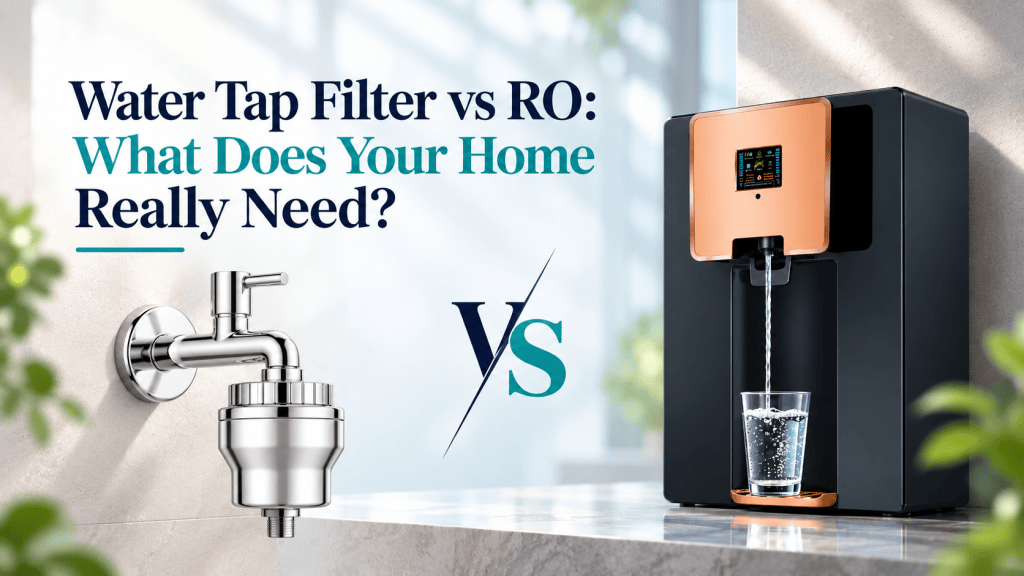
You have a purifier for drinking water. What about your bathing water?
You fill your drinking glass from the RO, then turn on a different tap to wash vegetables, rinse utensils, or fill your bathing bucket. Yet it is part of your routine from morning to night.
When comparing a water tap filter vs RO, start with where you need treatment. A kitchen RO and a bathroom tap filter serve different purposes. Understanding those roles and knowing the difference decides whether your whole home is protected or just one glass of drinking water.
Water Tap Filter vs RO: What Each One Actually Does
A water tap filter treats water as it flows through a tap. Depending on the cartridge, it can condition hard water, reduce chlorine smell, and trap particles such as rust and sand. Most basic tap filters work without electricity and do not produce a separate wastewater stream. They treat water only at the outlet where they are fitted.
An RO purifier pushes water through a semi-permeable membrane under pressure. This reduces dissolved salts, including minerals that cause hardness. Domestic RO systems commonly use an electric pump and release some water as reject water. They usually supply a dedicated outlet for drinking and cooking.
| Feature | Water tap filter | Kitchen RO purifier |
| How it works | Uses filtration layers and media, depending on the model | Uses a membrane under pressure |
| Main purpose | Filtration at a specific tap for suitable everyday uses | Treatment of drinking and cooking water |
| Electricity | Usually not required | Commonly required for the pump |
| Sediment removal | Traps particles within its filtration rating | Usually includes sediment pre-filtration |
| Water flow | Filters water as the tap runs | Produces purified water more slowly, often stored in a tank |
| Maintenance | Cleaning and cartridge replacement | Filter replacement, membrane checks and servicing |
| Daily use | Can serve a compatible outlet | Usually supplies a dedicated purified-water tap |
| Drinking-water suitability | Must be verified for the model and water quality | Depends on system performance, water quality and maintenance |
The choice depends on how you use the water. A suitable tap filter can address specific bathing and washing concerns, while an RO can treat drinking water where dissolved contaminants require removal. Some homes need both.
Why Different Taps in Your Home Need a Different Answer
A BIS study of piped water across 21 Indian state capitals found that the most common failures weren’t exotic contaminants. They were turbidity, total hardness, and total dissolved solids, the ordinary stuff that reaches every tap in a home, not just the kitchen sink. Under the Jal Jeevan Mission’s water quality monitoring framework, water quality surveillance is meant to extend to the household level, not just the treatment source, reinforcing that the tap you bathe or wash at deserves the same attention as the one you drink from.
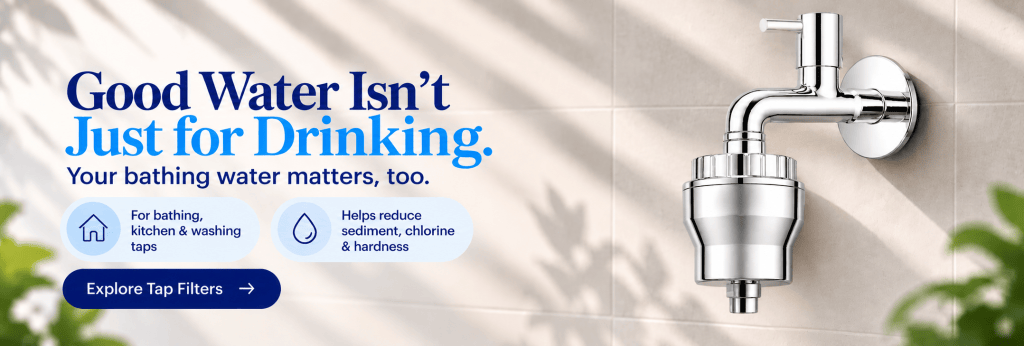
Bathing water: You use it to wash your skin and hair every day. Sediment, chlorine smell, and soap residue are reasons to check its quality. An RO purifier in the kitchen does not treat your bathroom tap or shower.
Kitchen tap water: You use it for cooking, rinsing vegetables, and washing utensils. Water used for cooking and food washing must be safe. A suitable tap filter can reduce sediment or chlorine, but it does not automatically make water safe to drink.
Washing water: Hard water can leave soap residue on clothes and cause scale inside washing machines and taps. Your water looks clean but isn’t actually filtered, so appearance alone cannot tell you what treatment it needs. A sediment filter catches particles, while hardness needs treatment designed to address dissolved minerals.
Good water quality matters at every tap, from your morning bath to your kitchen sink.
Choose treatment that suits both your water quality and how you use it.
RO, Tap and Sediment Filters Serve Different Purposes
RO can reduce dissolved salts in drinking water. Under IS 10500:2012, the acceptable TDS limit is 500 mg/l. The permissible limit is 2,000 mg/l when no alternative source is available. If your water exceeds the acceptable limit, testing can help you choose suitable treatment.
A kitchen RO usually supplies one drinking-water outlet. It does not treat the water used for bathing and washing elsewhere in your home. Sediment can also clog filters and affect RO performance. Installing a suitable RO pre-filter before the purifier helps catch particles before they reach the system.
Each filter has a different role. Tap filters treat their connected outlets, while an upstream sediment filter helps protect your purifier. It’s better to understand how sediment filters support RO and UV systems.
So Which One Does Your Home Actually Need?
If your main concern is high TDS in drinking water, an RO may be suitable. However, it treats only the water supplied through its dedicated outlet and does not address the water you use for bathing, laundry, or washing utensils.
A tap filter for hard water treats a compatible outlet that your kitchen RO does not reach. Choose a model that addresses your water problem, such as sediment or chlorine. Hardness may need separate treatment.
Many tap filters are easy to fit, though some taps need an adapter. If you also use an RO, check whether it needs a pre-filter to help protect it from sediment.
Choose Filters for Your Daily Water Needs
Tap filters are easy to install on compatible kitchen and bathroom taps. They help address sediment and chlorine, depending on the model. Some taps may need an adapter.
For sediment across your home, a mainline sediment filter catches particles before they reach taps and connected appliances, including an RO purifier. Mainline installation may need a plumber.
When the cartridge needs replacing, use a compatible spun filter cartridge without replacing the whole housing.
Note: Tap and shower filters do not reduce Total Dissolved Solids (TDS). If high TDS in drinking water is your main concern, consider a suitable RO purifier based on water testing.
Final Thoughts
Give your bathing, kitchen, and washing water attention too.
A water tap filter and an RO purifier aren’t competing for the same job. One protects drinking water from dissolved solids; the other protects every tap you touch daily from sediment, chlorine, and hardness.
Most homes need both, working at different points, not one standing in for the other.
Frequently Asked Questions About Water Tap Filters
Can a water tap filter replace an RO purifier?
No. A tap filter removes hard water, sediment, and chlorine through physical filtration, but it doesn’t reduce TDS. If your drinking water has high dissolved solids, you still need an RO purifier alongside it.
Does a water tap filter reduce TDS?
No. Tap filters work through physical filtration only. For TDS reduction in drinking water, pair a tap filter with an RO purifier; RiverSoft’s tap filters are designed for hard water, sediment, and chlorine, not dissolved solids.
Should I install a tap filter if I already have an RO?
Yes, especially for your bathroom, kitchen, and washing taps, which an RO purifier doesn’t cover. A mainline sediment filter ahead of your RO also helps the membrane last longer.
Why does bathing water need filtering if it’s not for drinking?
Hard water and chlorine affect skin and hair with daily exposure, even when the water is safe to bathe in. A tap or shower filter reduces this contact without the cost or waste of an RO at every tap.


Leave a Reply