Clean-looking water can hide more than you think.
Turn on your kitchen or bathroom tap and the water looks clean enough to use without a second thought. But clear doesn’t mean filtered. Indian tap water, whether it comes from a municipal line, a borewell, or a tanker-fed overhead tank, usually carries sediment, chlorine, and dissolved minerals you can’t see.
A tap water filter is built to catch exactly that before it reaches your hands, your utensils, or your skin. Here’s how it actually works, and why installing one isn’t optional anymore.
What Is a Tap Water Filter and How Does It Actually Work?
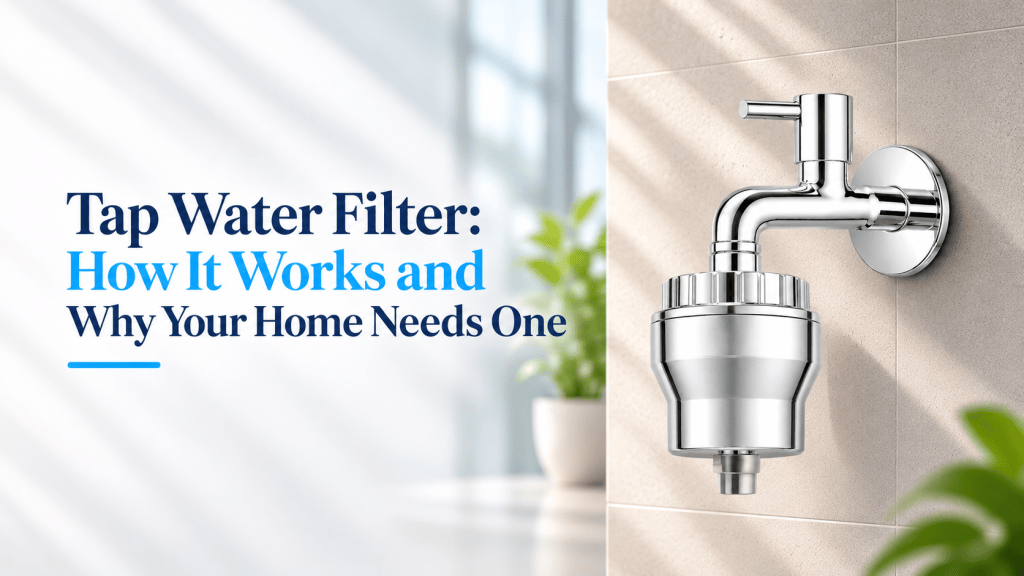
A tap water filter is a compact, point-of-use device that fits directly onto your kitchen or bathroom tap. Unlike an RO purifier, it doesn’t use a membrane or electricity. It works through layered physical filtration.
A tap water filter treats water at the outlet where you use it. When its filtration media match your water problem, it becomes a practical everyday essential. You can improve water quality at one tap without installing a treatment system for the entire home.
Why Your Tap Water Needs Filtering in the First Place
India’s tap water doesn’t come from one source. It could be groundwater from a borewell, municipal supply treated centrally, or tanker water from a nearby lake, all stored in an overhead tank for days. Each route picks up something extra:
- Sediment from ageing pipes
- Chlorine from treatment
- Dissolved minerals from the ground itself.
The Bureau of Indian Standards, under IS 10500:2012, sets an acceptable limit of 500 mg/l for Total Dissolved Solids and 200 mg/l for total hardness, with maximum permissible limits rising to 2000 mg/l and 600 mg/l respectively. Plenty of households on borewell or tanker supply sit well above the acceptable range without knowing it, because dissolved minerals don’t change how water looks.
That’s part of why your water looks clean but isn’t actually filtered.
Sediment, Chlorine, and Hardness: What a Tap Filter Removes and What It Doesn’t
A tap water filter earns its place by doing a few things reliably well. It catches sediment, rust, and sand before they clog your tap aerator or stain your fittings. It cuts chlorine odour and improves taste. Depending on the cartridge, it also slows limescale formation on steel and glass around the sink.
What it doesn’t do matters just as much as what it does:
- It’s not a replacement for an RO purifier if high TDS is your main drinking water concern
- It won’t remove dissolved minerals at a chemical level.
- It doesn’t work as a water softening system for the whole house.
This is also where sediment filters earn their keep for homes with visibly murky water, and where knowing how RO filters actually affect TDS helps you decide if you need a tap filter, a purifier, or both.
What Should You Check Before Buying a Tap Filter?
Start with your water source and the problem you want to solve. Municipal supply, borewell water, and tanker water can require different treatment approaches. Under the Jal Jeevan Mission’s water quality framework, water quality can vary significantly depending on the source, be it groundwater, municipal supply, or tanker-fed storage, which is part of why testing matters more than visual checks.
Then check these details:
- Tap compatibility: Confirm the outlet shape, thread, and adapter requirements.
- Filtration purpose: Look for specific removal claims rather than relying on “multi-stage” wording.
- Flow requirements: Check whether the model suits your water pressure.
- Temperature limits: Confirm suitability before connecting it to hot water.
- Replacement availability: Include cartridge cost and availability in your decision.
Why a Tap Water Filter Is a Must-Buy, Not a Maybe
Water should be cleaned at the last point of use. A tap filter does exactly that. It is required whether you have a full house filtration system in place or not. Choosing the right filter at the point of use gives you the peace of mind needed before consuming or using the water that has travelled from the pipelines
Installing a tap filter for hard water takes a few minutes. No plumber, no wiring, no permanent change to your fittings. A tap filter can be installed at the following locations
- Bathroom – For bathing water, protects your body and hair from murky water and even hard water damage, depending on the filter type.
- Kitchen – For kitchen consumption or washing utensils. It can reduce limescale deposits on the utensils and sink from hard water.
In high-sediment areas, tap filter maintenance basics can help you know how often to clean or swap the cartridge, so it keeps performing instead of becoming one more thing you forget about.
Tap Filters: Simple, DIY Installation
Tap filters are designed for Indian homes and offer easy fitting on compatible kitchen and bathroom taps. Some taps may need an adapter.
For homes using borewell or tanker water with more sediment, a mainline sediment filter catches particles before they reach taps across the house. When your tap filter cartridge needs changing, fit a replacement filter cartridge without replacing the whole unit.
Note: Tap and shower filters do not reduce Total Dissolved Solids (TDS). For drinking water, choose a suitable purifier based on your water quality. An RO pre-filter helps protect an RO system from sediment but does not make water safe to drink on its own.
Conclusion
A tap water filter works through simple, layered physical filtration, not a membrane.
It earns its place in the bathroom and kitchen to solve a specific, recurring water problem. The strongest reason to buy one is simple: it treats water at the outlet you use every day.
It can catch sediment, cut chlorine smell, and slow down limescale. It’s one of the easiest, most overdue upgrades for any Indian home. You cannot replace your home’s water supply overnight. But you can start with the tap you use every day.
Better to choose one that suits your home and solves your problem.
Frequently Asked Questions About Tap Water Filters
Does a tap water filter reduce TDS?
No. A tap filter does not reduce TDS. They can help in removing physical sediments and reducing chlorine, not dissolved solids. If high TDS is your main concern, only RO purifiers can reduce TDS.
How often should I change a tap filter cartridge?
Every 3 to 6 months on average, depending on your water’s sediment load. Borewell or tanker-fed homes usually need more frequent changes. Cartridges can be quickly swapped without replacing the whole unit.
Can I install a tap water filter myself?
Yes. Most tap filters are built for direct, tool-free fitting onto standard taps. No plumber or wiring needed, which is why they work well for rented homes too.
Is a tap filter enough, or do I also need an RO?
Tap filters do not make water drinkable. To make water with high TDS fit for drinking, using an RO purifier is essential


Leave a Reply